
How to Choose a POS System in Kenya: A Buyer’s Checklist for 2026
5 min readBy Isoftke Software Solutions
Every business that sells over a counter in Kenya eventually hits the same problems: queues at peak hours, M-Pesa and cash that don’t match the day’s sales, and stock that seems to disappear. The right point of sale system fixes all three. The wrong one adds another monthly bill and another thing that breaks.
New to POS systems? Start with our overview of the best POS system in Kenya. This guide is the practical checklist: what a POS should do, how to choose one for your type of business, what affects the cost, and the questions to ask any POS vendor before you pay.
What is a POS system?
A POS (point of sale) system is the software, and usually a tablet, computer or phone, that you use to record sales. A good one does much more than ring up items: it records how each sale was paid, updates your stock, tracks who sold what, and gives you reports you can trust.
What makes the best POS system in Kenya?
There is no single best POS for every business, but the best ones for Kenyan businesses share these features.
1. M-Pesa built in
Most Kenyan customers pay by M-Pesa. Your POS should record M-Pesa and cash separately on every sale, so at the end of the day you know exactly how much should be in the drawer and how much in M-Pesa.
2. Fast checkout
At lunch hour or month-end, seconds matter. Look for a till where staff can find items quickly by search or category and complete a sale in a few taps.
3. Stock control that updates itself
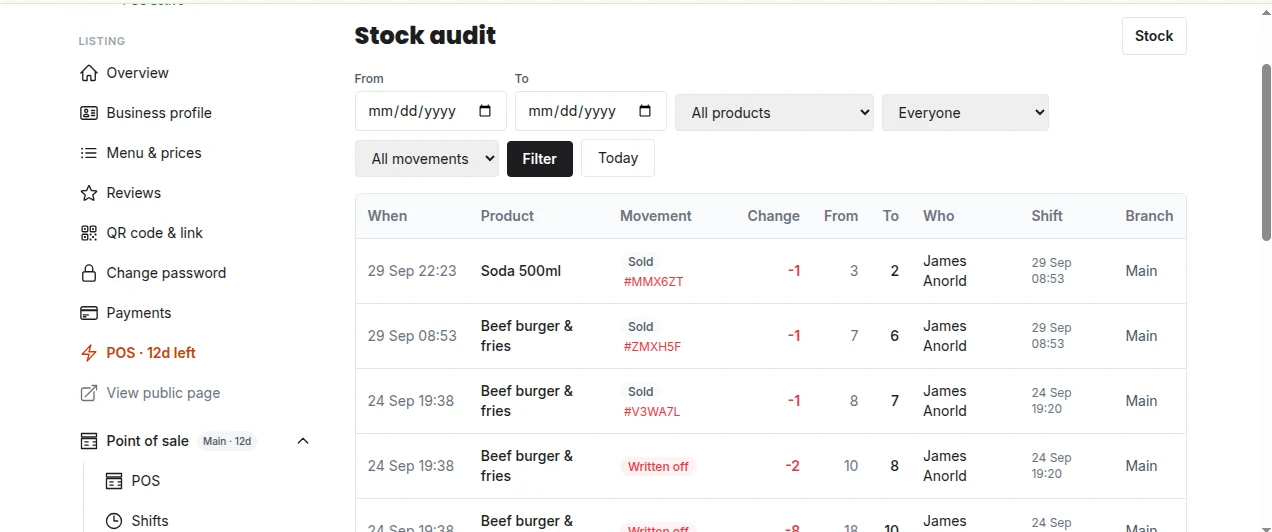
Every sale should reduce stock automatically. The best systems warn you when items are running low and keep an audit of every movement, including write-offs, so losses can be traced.
4. Shifts and cash drawer reconciliation
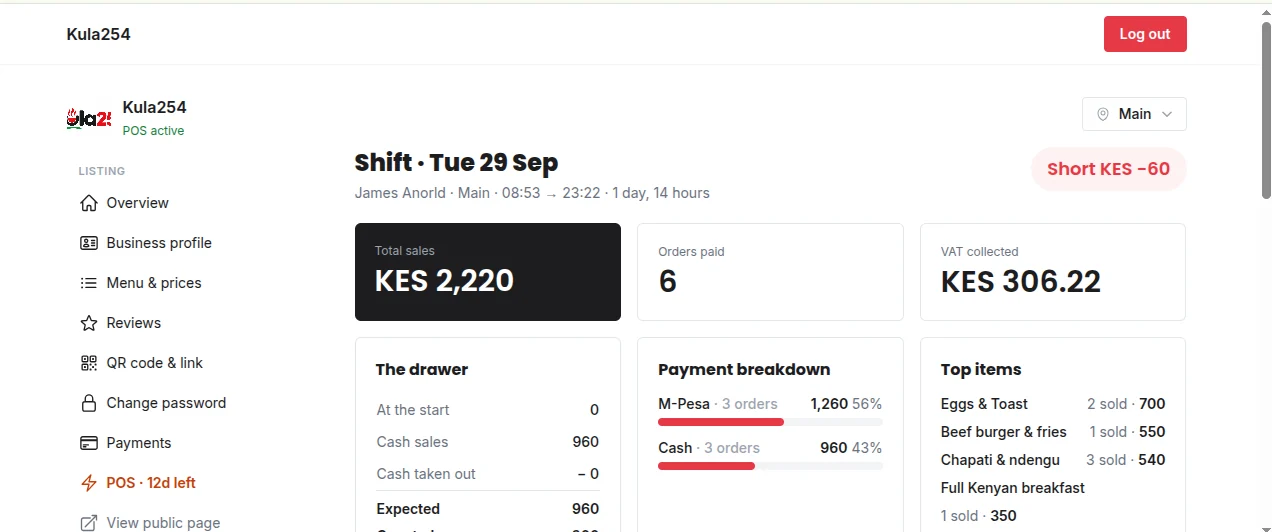
This is where many businesses lose money without noticing. A good POS lets each cashier open and close a shift, calculates the expected cash in the drawer, and shows any shortage or excess immediately.
5. Reports you will actually use
Daily sales, payment breakdown, VAT collected and best-selling items should be one click away, not a spreadsheet you build yourself.
6. Support for more than one branch
Even if you have one shop today, choose a POS that records sales, shifts and stock per branch, so you can grow without changing systems.
7. Local support
When the till stops working on a Saturday, you need someone in Kenya who picks up the phone. Ask where support is based and how quickly they respond.
8. Room to grow into accounting and ERP
As you grow, you will want sales and stock to flow into your accounts, purchasing and HR. A POS that is part of a wider ERP system saves you a painful switch later.
The best POS system for your type of business
Restaurants, cafés and takeaways
Restaurants need menu items with photos and prices, takeaway or table orders, order notes for the kitchen, and tight shift cash-ups. See what to look for in a restaurant POS system in Kenya.
Shops, minimarts and retail
Retail needs fast checkout, accurate stock with low-stock alerts, and clear records of who sold what in each shift.
Businesses with several branches
Look for per-branch sales, stock and shift reports, with one view across the whole business.
How much does a POS system cost in Kenya?
POS prices in Kenya vary a lot, and the cheapest option is rarely the cheapest over a year. The main things that affect cost are:
- Software: a one-off licence or a monthly subscription, often priced per till or per branch.
- Hardware: a tablet, computer or phone, plus a receipt printer and cash drawer if you need them.
- Setup: loading your products or menu, prices and staff accounts.
- Training and support: whether help is included or charged separately.
When comparing quotes, add up the total cost for your first year, including support, not just the headline price.
Questions to ask before you buy a POS system
- How are M-Pesa and cash payments recorded, and how do I reconcile them at the end of a shift?
- Does stock update automatically with every sale, and can I see an audit of stock movements?
- What reports do I get, and can I see them from my phone?
- Can I add a second branch later without changing systems?
- Where is support based, and what happens if the system stops working?
- Who owns my sales data, and can I export it?
- Can I see a live demo with my own products before I pay?
Red flags to watch out for
- No proper M-Pesa recording, leaving you to match payments by hand.
- No shift or cashier records, so shortages can’t be traced to a person or a time.
- Support only by email from outside Kenya.
- No demo, or a demo that only shows slides instead of the working system.
Isoftke POS: built for Kenyan businesses
Our POS system in Kenya was built by our team in Nairobi around the checklist above. It gives you:
- A fast till with your products or menu, takeaway or table orders and order notes.
- M-Pesa and cash recorded on every sale.
- Shifts with cash drawer reconciliation that flags shortages.
- Low-stock alerts and a full stock audit by item, cashier and shift.
- Shift reports with total sales, VAT collected, payment breakdown and top items.
- Branches, and a path into our ERP for accounting, inventory and CRM.
Frequently asked questions
What is the best POS system in Kenya?
The best POS system in Kenya is one that records M-Pesa and cash on every sale, updates stock automatically, closes each shift with a clear cash-up, and comes with local support. Match the system to your business type, and always ask for a demo with your own products.
Which POS is best for a restaurant in Kenya?
Choose a POS with a menu-based till, takeaway and table orders, order notes and strong shift reports. See our guide to the restaurant POS system in Kenya.
Can a POS system accept M-Pesa?
Yes. A good POS records M-Pesa payments against each sale and shows the M-Pesa and cash totals for every shift, so reconciling is quick.
Do I need special hardware for a POS?
Not always. Many modern POS systems run on a tablet, computer or phone. Ask the vendor what they recommend for your volume of sales.
Ready to see a POS working with your own products? Request a demo or call +254 795 289 968.
Keep reading
Best POS System in Kenya
Whether you run a supermarket, a hardware store, a pharmacy, a wines and spirits shop, a boutique, a restaurant, or a wholesale business, the point of sale…
Best Kinyozi and Barbershop Management System in Kenya: Run a Sharper, More Profitable Business
The kinyozi is one of the most reliable businesses in Kenya. From busy estates in Nairobi to town centres in Mombasa, Nakuru, Kisumu, and Eldoret,…
Best Spa Management System in Kenya: Run a Relaxing, Profitable Wellness Business
Kenya's wellness industry is thriving. As more Kenyans invest in self-care, relaxation, and wellbeing, spas, wellness centres, and massage studios are…
Need A Consultation?
We are here to answer your questions 24/7