
Top ERP Software in Kenya: The Best ERP Systems and Solutions for Growing Businesses
6 min readBy admin
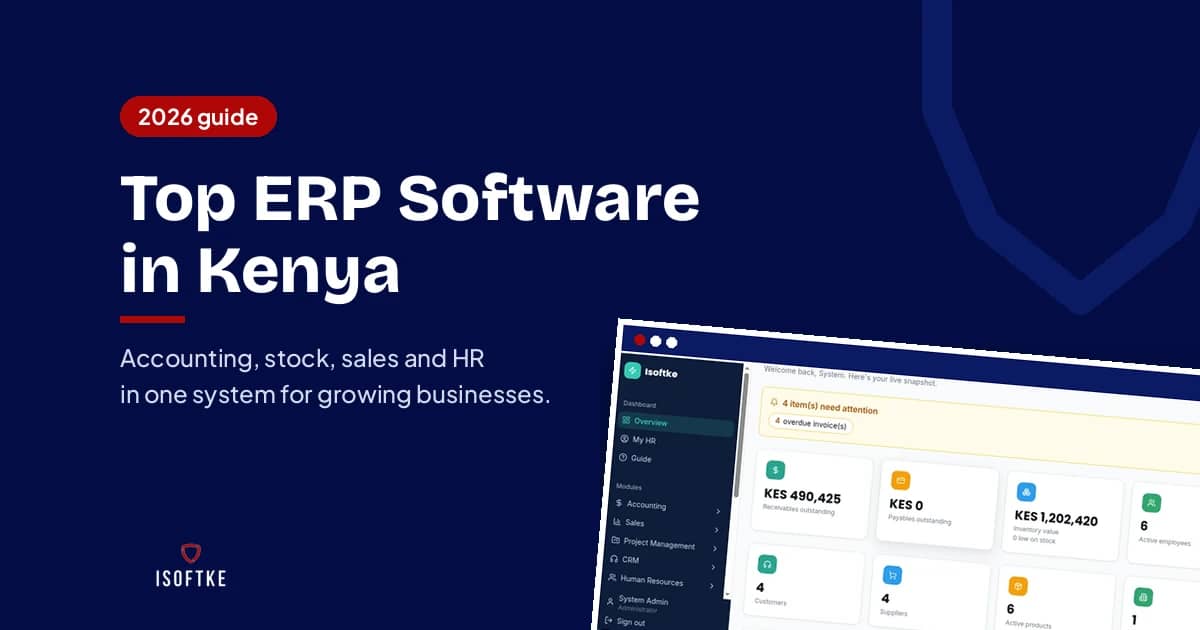
As businesses across Kenya scale up, the tools they used in their early days start to fall apart. Spreadsheets multiply, departments work in silos, stock goes missing, and management loses sight of what's actually happening across the company. This is exactly the problem that ERP software in Kenya is built to solve.
Whether you run a manufacturing plant in Athi River, a distribution business in Nairobi's Industrial Area, a retail chain across multiple counties, or a services firm in Mombasa, the right Enterprise Resource Planning system can transform how you operate. In this guide, we'll explain what ERP software is, why it matters for Kenyan businesses, the key features to look for, and how to choose the best ERP solution for your company.
What Is ERP Software?
ERP stands for Enterprise Resource Planning. In simple terms, an ERP system is a single, integrated software platform that connects every part of your business — finance, sales, inventory, procurement, human resources, manufacturing, and more — into one unified system.
Instead of running separate, disconnected tools for accounting, stock control, payroll, and customer management, an ERP brings them all together. Data flows automatically between departments, so a sale recorded by your sales team instantly updates your inventory, your accounts, and your reports. Everyone works from the same accurate, real-time information.
For growing businesses in Kenya, this shift from fragmented tools to a single connected platform is often the difference between chaos and control.
Why Kenyan Businesses Need ERP Software
The Kenyan business landscape is competitive and fast-moving. Companies that want to grow profitably need visibility, efficiency, and the ability to make decisions based on accurate data. Here's why ERP systems in Kenya have become essential rather than optional.
Eliminate data silos. When your finance, sales, and warehouse teams each keep their own records, errors and disagreements are inevitable. An ERP creates one single source of truth that everyone shares.
Real-time visibility. Good management depends on knowing what's happening right now, not last month. ERP dashboards give owners and managers instant insight into cash flow, stock levels, sales performance, and more.
Better inventory and stock control. For traders, distributors, and manufacturers, stock is money. ERP inventory management tracks every item in real time, reduces wastage and theft, and ensures you never run out of fast-moving products or over-order slow ones.
Streamlined accounting and compliance. A strong ERP handles your accounting, VAT, and reporting needs in one place, making tax season far less painful and reducing costly errors.
Scalability. As your business grows and adds branches, products, or staff, an ERP grows with you. You won't need to rip everything out and start again every time you expand.
Improved customer service. With all customer information, order history, and inventory data in one place, your team can respond to customers faster and more accurately.
The M-Pesa Advantage: ERP Built for the Kenyan Market
One of the biggest differences between generic international ERP products and ERP solutions in Kenya designed for the local market is payment integration. In Kenya, mobile money runs the economy. Any serious business system needs to work seamlessly with M-Pesa.
An ERP that integrates with M-Pesa lets you receive payments, reconcile transactions automatically, and keep your accounts up to date without endless manual data entry. This local-first approach saves hours of work every week and removes the reconciliation headaches that come with matching mobile money payments by hand.
When you're evaluating ERP software companies in Kenya, prioritise those that understand local realities — M-Pesa, SMS communication, and the way Kenyan businesses actually operate — over foreign vendors who force you to adapt to systems built for entirely different markets.
Key Modules and Features of a Good ERP System
The best ERP software in Kenya is modular, meaning you can use the parts your business needs and add more as you grow. Here are the core modules to look for:
Financial management and accounting. The heart of any ERP. This module handles your general ledger, accounts payable and receivable, bank reconciliation, financial reporting, and tax compliance.
Inventory and warehouse management. Real-time tracking of stock across one or many locations, with alerts for low stock, batch and expiry tracking, and accurate valuation.
Sales and CRM. Manage your sales pipeline, quotations, invoices, and customer relationships in one place, with a full history of every customer interaction.
Procurement and purchasing. Streamline how you order from suppliers, track deliveries, and manage supplier relationships and costs.
Human resources and payroll. Manage staff records, leave, attendance, and run accurate payroll that accounts for PAYE, NHIF, NSSF, and other statutory deductions.
Manufacturing and production. For manufacturers, this module manages bills of materials, production planning, and shop-floor operations.
Reporting and business intelligence. Powerful, customisable reports and dashboards that turn your data into decisions.
M-Pesa and payment integration. Seamless mobile money and bank integration tailored to the Kenyan market.
Cloud ERP vs On-Premise: What's Right for Your Business?
When choosing ERP software in Kenya, you'll come across two main deployment options.
Cloud ERP is hosted online and accessed through a browser or app. It requires no expensive servers, updates automatically, and lets you access your business from anywhere with an internet connection. Cloud ERP in Kenya has become increasingly popular because of its lower upfront cost, easier maintenance, and flexibility, especially for businesses with multiple branches.
On-premise ERP is installed on your own servers and hosted within your premises. It offers more direct control and can work well for businesses with specific data-residency requirements or limited internet reliability, but it usually carries higher upfront costs and requires in-house IT support.
For most small and medium-sized businesses in Kenya, cloud ERP offers the best balance of affordability, flexibility, and ease of use.
How to Choose the Best ERP Software in Kenya
With several options on the market, here's how to narrow down the right ERP system for your business.
Match it to your industry. A retail business has different needs from a manufacturer or a services firm. Choose a provider who understands your sector.
Insist on local support. When your business depends on a system, you need a support team you can actually reach. Local ERP providers offer responsiveness and understanding that overseas vendors rarely match.
Check for M-Pesa integration. Make sure the system handles mobile money out of the box.
Prioritise ease of use. The most powerful system in the world is useless if your team won't use it. Look for a clean, intuitive interface.
Think about scalability. Choose a modular solution that can grow with you, so you're not forced to switch systems as you expand.
Consider total cost. Look beyond the sticker price to implementation, training, support, and how pricing scales as you add users or branches.
Get the Right ERP Solution for Your Business
At iSoft Kenya, we provide robust, locally-built ERP solutions in Kenya designed for the realities of doing business here. Our ERP software brings your finance, inventory, sales, procurement, HR, and payroll together in one connected system, with M-Pesa integration built in.
We work with businesses across manufacturing, distribution, retail, and services to streamline operations, improve visibility, and unlock growth. Whether you're moving off spreadsheets for the first time or upgrading from a system that no longer fits, we'll help you implement an ERP that actually works for your team.
Ready to Transform Your Business with ERP?
If your business has outgrown spreadsheets and disconnected tools, it's time to consider a proper ERP system. The right platform will give you control, clarity, and the foundation to scale with confidence.
Get in touch with us today for a free consultation and a quote tailored to your business:
- Phone / WhatsApp: +254 795 289 968
- Email: info@isoftke.co.ke
Take the first step toward smarter, more efficient operations. Contact iSoft Kenya and discover how the right ERP software can move your business forward.
Keep reading
Best POS System in Kenya
Whether you run a supermarket, a hardware store, a pharmacy, a wines and spirits shop, a boutique, a restaurant, or a wholesale business, the point of sale…
How to Choose a POS System in Kenya: A Buyer’s Checklist for 2026
Every business that sells over a counter in Kenya eventually hits the same problems: queues at peak hours, M-Pesa and cash that don’t match the day’s sales,…

Best Web Design Company in Kenya
Almost every business in Kenya now understands that it needs a website. What's far less obvious is who should build it. Search for a web design company in…
Need A Consultation?
We are here to answer your questions 24/7